
How to Calculate ARV Before Buying a San Antonio Investment Property
How to Calculate ARV Before Buying a San Antonio Investment Property
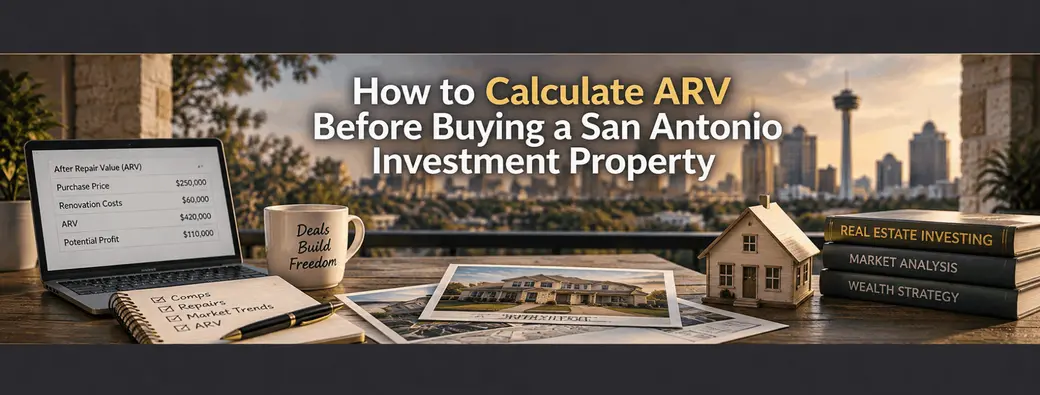
The short answer: ARV, or After Repair Value, estimates what a property could realistically be worth after renovations. For San Antonio investors, a defensible ARV can help determine maximum purchase price, renovation budgets, potential flip margins, and whether a BRRRR refinance may work.
Finding a fixer-upper at a low price doesn't automatically mean you've found a good real estate deal.
For investors, one of the most important questions comes next:
What could this property realistically be worth after the renovations are complete?
That's where After Repair Value, or ARV, comes in.
Whether you're considering a fix-and-flip, BRRRR property, or another value-add investment in San Antonio, understanding ARV can help you decide how much you can afford to pay—and when it's better to walk away.
Investor takeaway: A low acquisition price doesn't automatically create a profitable investment. The property's realistic value after renovation is one of the numbers that determines whether the opportunity deserves a closer look.
What Is ARV in Real Estate?
ARV stands for After Repair Value.
It's an estimate of what a property could be worth after the necessary renovations and improvements have been completed.
For example, imagine you're looking at a dated San Antonio home listed for $185,000.
After reviewing comparable renovated homes nearby, you estimate the property could potentially be worth $285,000 once updated.
Purchase Price: $185,000
Estimated ARV: $285,000
Difference: $100,000
That $100,000 difference might look exciting.
But it isn't automatically your profit.
You still have to account for renovation expenses, financing, closing costs, holding costs, selling expenses, and unexpected repairs.
Reality check: ARV is the starting point of the analysis—not the final answer.
Why ARV Matters for San Antonio Investors
Investors often make money by buying a property at the right basis and creating value.
If you overestimate the property's future value, the entire deal can change.
Imagine you purchase a property expecting:
Expected ARV: $300,000
Actual Supported Value: $270,000
Difference: $30,000
Depending on your margins, that $30,000 difference could dramatically reduce—or potentially eliminate—the expected profit.
A conservative, evidence-based ARV can help you determine:
- Your maximum purchase price
- How much renovation makes sense
- Whether there's enough margin in a flip
- Whether a BRRRR refinance could work
- Whether you're taking on too much risk
The goal isn't to find the highest possible ARV. It's to find the most defensible ARV.
Step 1: Find Recently Sold Comparable Properties
The first place to start is with comparable sales, often called comps.
Look for recently sold properties that are genuinely similar to the investment property you're evaluating.
Strong comps generally have similarities in:
- Location
- Property type
- Square footage
- Bedroom count
- Bathroom count
- Lot size
- Age
- Construction style
- Garage or parking
- Renovation level
- Overall condition
For a potential 3-bedroom, 2-bath, 1,600-square-foot single-family home, a renovated 3-bedroom, 2-bath home around the same size and nearby may provide useful evidence.
A 4,000-square-foot luxury property several neighborhoods away probably won't.
Step 2: Stay as Close to the Property as Possible
Location can have a major impact on value.
Two homes with identical floor plans can sell for different prices because they're located in different subdivisions, school districts, HOA communities, or even different sections of the same neighborhood.
That's especially important in a large and diverse market like San Antonio.
Start with properties in the same subdivision or immediate neighborhood whenever possible.
If there aren't enough recent sales, gradually expand the search rather than immediately jumping several miles away.
Investor takeaway: The closer and more similar the comparable property, the more useful it may be when supporting your ARV.
Step 3: Compare Renovated Properties to Your Renovation Plan
This is where investors sometimes get overly optimistic.
If your ARV comp has:
- Fully remodeled bathrooms
- Quartz countertops
- New cabinets
- Updated flooring
- New fixtures
- Fresh exterior improvements
...but your rehab budget only includes paint and inexpensive flooring, you can't automatically assume your property will command the same price.
Your renovation plan needs to support the value you're projecting.
Ask yourself: Will my finished property actually compete with the homes I'm using as ARV comps?
If the answer is no, adjust your assumptions.
Step 4: Pay Attention to Square Footage
Price per square foot can be useful, but investors shouldn't rely on it alone.
Suppose renovated homes nearby sold for:
Comp 1: $280,000
Comp 2: $292,000
Comp 3: $287,000
If they're reasonably similar to your property, those sales begin creating a range.
Now imagine they're all between 1,550 and 1,700 square feet and your property is 1,620 square feet.
That's much more useful than comparing your property to a renovated 2,800-square-foot home.
Investor takeaway: Use price per square foot as supporting information—not a shortcut that replaces a full comparable analysis.
Step 5: Look at What Buyers Are Actually Paying
Active listings can help you understand your competition.
But remember:
Listing price is not the same as market value.
A seller can ask anything.
Sold properties show what buyers have actually been willing to pay.
That's why closed sales generally carry more weight when you're estimating ARV.
Pending listings can also provide useful clues about current demand, although the final sales price may not yet be available.
Step 6: Don't Ignore Days on Market
Look beyond the final sale price.
Ask how long renovated properties took to sell.
If remodeled homes around your projected ARV are selling quickly, that may indicate stronger demand.
If they're sitting for months and repeatedly reducing their prices, that tells a different story.
Your exit strategy matters just as much as your acquisition strategy.
Reality check: A flip isn't finished when the renovation ends. It's finished when the property sells.
Step 7: Calculate the Entire Deal
Once you have a reasonable ARV, you can start evaluating whether the opportunity actually works.
Consider a hypothetical San Antonio flip:
Purchase Price: $180,000
Estimated Rehab: $40,000
Estimated ARV: $290,000
Initial Spread: $70,000
At first glance:
$290,000 - $180,000 - $40,000 = $70,000
But calling that $70,000 your expected profit would be a mistake.
You may still need to account for:
- Purchase closing costs
- Financing costs
- Interest
- Property taxes
- Insurance
- Utilities
- Landscaping
- Maintenance
- Permits
- Unexpected repairs
- Selling expenses
- Closing costs at resale
A contingency for unexpected construction expenses can also be important.
That's exactly why investors should analyze the complete project before submitting an offer.
What About the 70% Rule?
You've probably heard investors mention the 70% rule.
A simplified version looks like this:
Maximum Purchase Price = (ARV × 70%) - Repairs
ARV: $300,000
70% of ARV: $210,000
Estimated Repairs: $40,000
Potential Maximum Purchase Price: $170,000
It's a quick screening tool.
But it shouldn't automatically determine what you offer.
Financing costs, holding periods, property taxes, insurance, construction costs, market conditions, expected returns, and exit strategies vary from deal to deal.
Investor takeaway: Use formulas to screen opportunities—not to replace detailed underwriting.
ARV Matters for BRRRR Investors Too
ARV isn't only for house flippers.
It's extremely important when evaluating a BRRRR strategy: Buy, Rehab, Rent, Refinance, Repeat.
A BRRRR investor is hoping that improvements create enough value to support a refinance after renovation.
Purchase: $160,000
Renovation: $35,000
Total Before Other Costs: $195,000
Estimated ARV: $275,000
That spread may look promising.
But your ability to recover invested capital will depend on factors including the actual appraisal, lender requirements, loan-to-value limits, seasoning requirements, interest rates, rental performance, and other financing terms.
Never assume the refinance will automatically return all of your original cash.
Common ARV Mistakes Investors Should Avoid
Using the Highest Comp
Don't find the most expensive sale in the neighborhood and automatically make it your ARV. Look for a defensible range.
Comparing Renovated Homes to Different Property Types
A one-story home shouldn't automatically be compared with a substantially larger two-story property simply because they're nearby.
Going Too Far Away
San Antonio values can change significantly between neighborhoods. Stay local whenever reliable comps are available.
Ignoring Property Features
Garages, pools, lot sizes, bathrooms, additions, busy roads, and other characteristics can affect buyer demand and value.
Assuming Every Renovation Adds Dollar-for-Dollar Value
Spending $60,000 on a renovation does not automatically increase a property's value by $60,000. The market determines the value.
Building Your Numbers Around the Deal You Want
If a deal only works when you use the highest possible ARV, lowest possible rehab estimate, shortest possible holding period, and best possible resale scenario, your margin for error may be extremely thin.
A Better Investor Question
Instead of asking:
"How high can I justify the ARV?"
Ask:
"What value can I confidently support with the available market evidence?"
That's a much safer way to approach investment analysis.
Good investors don't need every property to work.
Sometimes the best investment decision is recognizing that the numbers don't make sense and moving on to the next opportunity.
Why Work With a San Antonio Investor-Focused Agent?
Finding a property is only one part of the investment process.
An investor-focused real estate agent can help you evaluate the market around the property, including:
- Comparable sales
- Recent neighborhood activity
- Days on market
- Price reductions
- Property history
- Potential ARV
- Rental comparables
- Resale competition
- Value-add opportunities
At Emerald Group, the goal isn't simply to send investors listings.
It's to help investors look at properties through an investment lens and identify opportunities that deserve deeper analysis.
Frequently Asked Questions
What does ARV mean in real estate?
ARV stands for After Repair Value. It estimates what a property could reasonably be worth after planned renovations and improvements are completed.
How do investors calculate ARV?
Investors typically analyze recently sold renovated properties that are similar in location, size, property type, condition, features, and renovation quality. The goal is to establish a defensible range based on actual market evidence.
Is the 70% rule a good way to calculate an offer?
The 70% rule can be useful as a quick screening method, but it shouldn't replace detailed underwriting. Financing, holding costs, renovation expenses, market conditions, selling costs, and required returns vary between investments.
Why is ARV important for BRRRR properties?
The property's post-renovation value can affect the refinance portion of a BRRRR strategy. However, the actual refinance will depend on the appraisal, lender guidelines, loan-to-value requirements, rental performance, and other financing terms.
Looking for Your Next San Antonio Investment Property?
Whether your strategy is fix-and-flip, BRRRR, buy-and-hold, or value-add investing, the right deal starts with the right numbers.
Tell us your budget, buy box, target neighborhoods, investment strategy, and rehab tolerance.
Ready to analyze your next San Antonio investment opportunity? Connect with Emerald Group and let's start looking for the numbers behind the listing.
This article is for general informational purposes and is not financial, tax, legal, appraisal, or investment advice. Investors should independently verify property values, comparable sales, renovation costs, rents, financing terms, and projected returns.
Recent Posts








"My job is to find and attract mastery-based agents to the office, protect the culture, and make sure everyone is happy! "