
How to Evaluate Flood Risk Before Buying an Investment Property in San Antonio
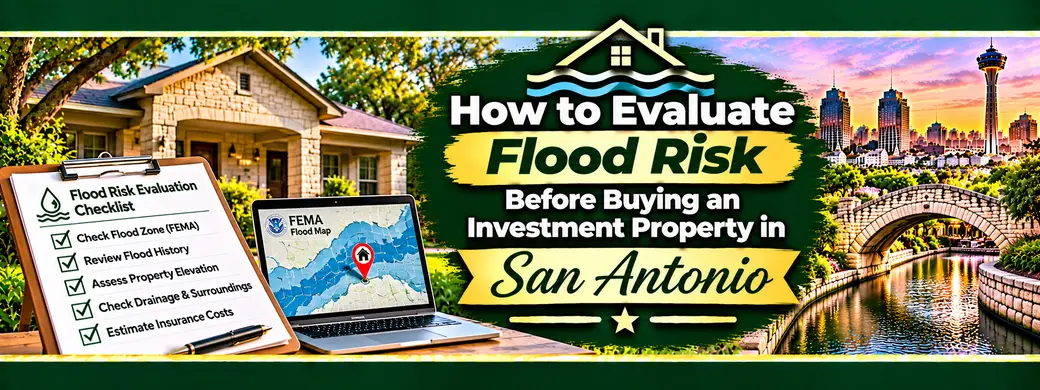
How to Evaluate Flood Risk Before Buying an Investment Property in San Antonio
When evaluating investment properties in San Antonio, investors often focus on purchase price, renovation costs, rental income, and potential resale value.
However, one factor that deserves attention is flood risk.
Flooding and drainage problems can affect a property's condition, insurance expenses, financing requirements, rental operations, and long-term value.
For investors considering rental properties, fixer-uppers, distressed homes, or BRRRR projects, researching flood exposure before purchasing can help prevent unexpected financial complications.
A property does not need to be located inside a mapped high-risk flood zone to experience flooding. Investors should evaluate both official flood maps and property-specific drainage conditions.
Here's a practical guide to evaluating flood risk before purchasing an investment property in San Antonio.
1. Understand Why Flood Risk Matters
Flooding can create expenses that extend beyond repairing visible water damage.
Potential financial consequences include:
- Structural damage
- Flooring and drywall replacement
- Electrical system repairs
- HVAC damage
- Mold remediation
- Tenant displacement
- Rental income interruptions
- Higher insurance expenses
- Reduced resale marketability
Even relatively localized drainage problems may affect property maintenance and tenant satisfaction.
Investors should evaluate flood exposure as part of their overall risk assessment.
2. Check FEMA Flood Maps
One of the first steps is reviewing the property's location using the Federal Emergency Management Agency's flood mapping resources.
FEMA provides flood hazard information through its Flood Map Service Center.
Official resource: FEMA Flood Map Service Center
Investors can search by property address and review available flood hazard information.
However, maps should be interpreted carefully.
Flood maps identify designated flood hazards but do not predict every possible flooding event.
3. Understand Common Flood Zone Designations
FEMA flood maps use different zone designations to describe flood hazards.
Zone A and AE
These zones generally identify areas with a 1% annual chance of flooding, commonly called the 100-year floodplain.
Zone AE includes mapped base flood elevations, while Zone A generally does not provide detailed base flood elevations on the map.
Zone X
Zone X can describe areas outside the mapped 1% annual-chance floodplain, including certain areas with moderate flood hazards.
Different Zone X designations represent different mapped conditions.
Being in Zone X does not guarantee a property will never flood.
Floodways
Regulatory floodways are areas associated with the conveyance of floodwaters and may be subject to additional development restrictions.
Investors should verify whether a property or planned improvement is affected by applicable floodway regulations.
Confirm the exact mapped designation and consult appropriate floodplain professionals when the property's location or proposed improvements raise questions.
4. Research Local Floodplain Information
FEMA maps are an important starting point, but local government resources may provide additional information.
For San Antonio properties, investors can review relevant resources through the City of San Antonio and applicable county authorities.
Official websites:
Depending on the property, local information may help clarify floodplain requirements, drainage concerns, and development restrictions.
Investors should confirm which jurisdiction governs the specific parcel.
5. Inspect the Property's Drainage
Even when a property is outside a mapped high-risk flood zone, poor drainage may create water intrusion problems.
During a property walkthrough, look for:
- Standing water near the foundation
- Ground sloping toward the home
- Clogged or damaged gutters
- Downspouts discharging near the foundation
- Erosion
- Water stains
- Damaged exterior materials
- Low-lying yard areas
- Blocked drainage paths
These conditions may warrant further evaluation by qualified inspectors or drainage specialists.
6. Research the Property's Flood History
Investors should investigate whether the property has experienced previous flooding or water intrusion.
Useful sources may include:
- Available seller disclosures
- Inspection findings
- Repair documentation
- Insurance information lawfully available
- Local flood event records
- Other reliable property-specific records
Past flooding does not automatically mean the property is unsuitable for investment.
However, it may indicate a need for additional inspections, repairs, or risk mitigation.
7. Understand Flood Insurance Requirements
Flood insurance is separate from many standard property insurance policies.
Typical homeowners or landlord insurance policies generally do not cover flooding as defined under flood insurance coverage.
For properties located in designated high-risk flood areas, lenders may require flood insurance depending on the loan and applicable federal requirements.
Investors should confirm:
- Whether flood insurance is required
- Available coverage options
- Annual premiums
- Deductibles
- Coverage limits
- Exclusions
- Applicable waiting periods
Flood insurance may also be worth considering for properties outside mapped high-risk areas.
8. Include Insurance in Your Investment Analysis
Insurance costs can affect rental property cash flow and the overall return on investment.
For example, consider a hypothetical rental property with the following annual expenses.
Hypothetical Insurance Cost Comparison
Annual Rental Income: $24,000
Annual Operating Expenses Before Flood Insurance: $10,000
Income Before Flood Insurance: $14,000
Illustrative Annual Flood Insurance Premium: $2,400
Income After Flood Insurance: $11,600
In this example, the additional insurance expense reduces annual income before financing by $2,400.
The figures are hypothetical and do not represent actual San Antonio flood insurance premiums.
Investors should obtain property-specific quotes before finalizing their calculations.
9. Evaluate Potential Repair and Mitigation Costs
Properties with known drainage concerns or previous flood damage may require additional improvements.
Potential expenses include:
- Drainage improvements
- Grading adjustments
- Gutter and downspout modifications
- Water-damaged material replacement
- Moisture remediation
- Foundation-related repairs
- Flood mitigation measures
Some improvements may require permits or professional engineering review.
Investors should obtain qualified recommendations before assuming a proposed improvement will resolve flooding concerns.
10. Consider Tenant Safety and Rental Operations
For buy-and-hold investors, flood exposure can affect long-term property management.
Important considerations include:
- Tenant safety
- Emergency access
- Potential displacement
- Maintenance responsibilities
- Insurance coverage
- Lease obligations
- Repair timelines
Flood damage can interrupt rental income and create additional responsibilities for landlords.
Investors should understand applicable Texas landlord-tenant requirements and maintain appropriate emergency plans.
11. Evaluate the Impact on Resale Value
Flood exposure may influence buyer demand, financing options, and resale marketability.
Investors should research comparable sales involving properties with similar location and flood risk characteristics.
Consider:
- Recent comparable sales
- Property condition
- Flood zone designation
- Insurance costs
- Prior damage and repairs
- Buyer financing requirements
Do not assume that two otherwise similar properties have identical values when their flood exposure differs.
12. Stress-Test Your Investment Numbers
Before purchasing, investors should evaluate how the property performs under less favorable scenarios.
For example:
- What if insurance premiums increase?
- What if drainage repairs cost more than expected?
- What if the property experiences water damage?
- What if rental income is interrupted?
- What if resale takes longer?
A conservative analysis can help investors determine whether the potential return justifies the risk.
Flood risk should be considered alongside purchase price, renovation costs, rental income, and long-term property maintenance—not treated as an afterthought.
13. Know When to Walk Away
Not every property with flood exposure is suitable for an investor's strategy.
Potential reasons to reconsider include:
- Unacceptable insurance costs
- Significant unresolved drainage problems
- Extensive previous water damage
- Financing limitations
- Prohibitive mitigation costs
- Insufficient projected cash flow
- Unacceptable long-term risk
Investors should establish clear criteria and avoid purchasing properties that exceed their risk tolerance.
Flood Risk Investment Checklist
- ☐ FEMA flood map reviewed
- ☐ Flood zone designation verified
- ☐ Local floodplain information researched
- ☐ Property drainage inspected
- ☐ Previous flood history investigated
- ☐ Seller disclosures reviewed
- ☐ Water intrusion concerns evaluated
- ☐ Flood insurance requirements confirmed
- ☐ Insurance quotes obtained
- ☐ Repair costs estimated
- ☐ Mitigation feasibility reviewed
- ☐ Financing requirements evaluated
- ☐ Comparable sales researched
- ☐ Rental cash flow calculated
- ☐ Exit strategy established
- ☐ Downside scenarios tested
Frequently Asked Questions
Can you buy an investment property in a flood zone in San Antonio?
Yes, properties in mapped flood zones may be purchased, but investors should evaluate insurance requirements, financing, property condition, and applicable development restrictions.
How do I check whether a San Antonio property is in a flood zone?
Start with FEMA's Flood Map Service Center and consult local floodplain resources when additional information is needed.
Does being outside a flood zone mean a property cannot flood?
No. Properties outside mapped high-risk flood zones can still experience flooding from heavy rainfall, drainage problems, or other causes.
Is flood insurance required for every rental property?
No. Requirements depend on the property's flood designation, lender, loan type, and other applicable conditions. Investors should confirm requirements with their lender and insurance provider.
Can flood risk affect property value?
Yes. Flood exposure, insurance expenses, previous damage, and buyer expectations may influence marketability and value.
Can Emerald Group help investors research San Antonio properties?
Emerald Group helps investors explore properties based on budget, location, condition, and investment objectives. Specialized flood risk evaluations should be completed by qualified professionals.
Work With an Investor-Focused San Antonio Real Estate Team
Finding a promising investment property involves more than identifying a low purchase price.
Understanding location-specific risks, insurance expenses, property condition, and financial performance is essential.
At Emerald Group, we help San Antonio investors identify real estate opportunities that align with their acquisition strategies and evaluate properties using relevant market information.
Whether you're searching for a rental property, fixer-upper, BRRRR project, or long-term investment, a clear due diligence process can help you make more informed decisions.
Looking for Investment Properties in San Antonio?
Tell Emerald Group your budget, preferred neighborhoods, property criteria, and investment strategy.
We'll help you explore available San Antonio real estate opportunities that align with your goals.
Explore San Antonio Investment PropertiesDisclaimer: This article is for general educational purposes only and does not constitute legal, financial, insurance, engineering, floodplain, lending, appraisal, or investment advice. Flood maps, insurance requirements, property conditions, and financial outcomes vary. All numerical examples are hypothetical. Investors should independently verify property information and consult qualified professionals before making investment decisions.
Categories
Recent Posts









"My job is to find and attract mastery-based agents to the office, protect the culture, and make sure everyone is happy! "