
How to Estimate Rehab Costs Before Buying a San Antonio Investment Property
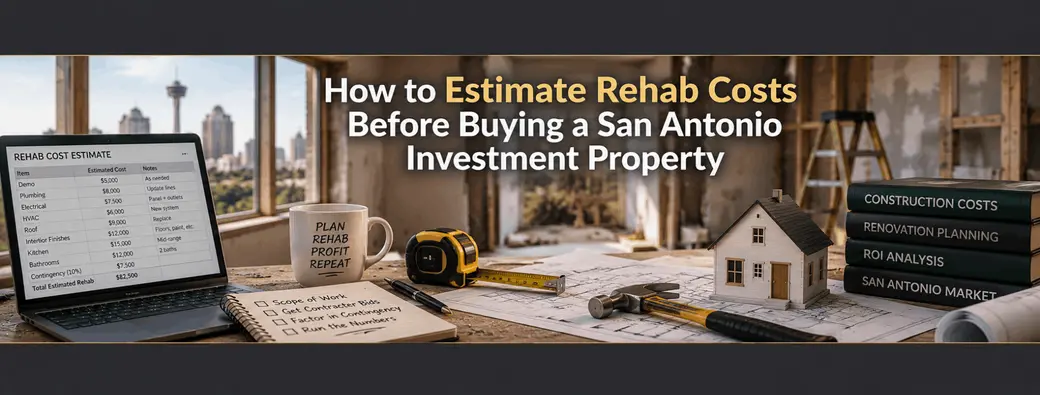
How to Estimate Rehab Costs Before Buying a San Antonio Investment Property
The short answer: A property's purchase price and ARV only tell part of the story. For San Antonio fix-and-flip and BRRRR investors, accurately estimating rehab costs is critical because underestimated repairs can quickly reduce the margin in an otherwise promising investment.
You find a San Antonio property listed at $190,000.
Comparable renovated homes are selling around $300,000.
At first glance, the deal looks promising.
But there's one number that can completely change the investment:
The rehab cost.
A renovation that you estimate at $35,000 but ultimately costs $60,000 can quickly eat into your expected return.
For fix-and-flip and BRRRR investors, accurately estimating repairs is just as important as negotiating the purchase price or calculating the After Repair Value (ARV).
Investor takeaway: Don't evaluate an investment based only on purchase price and ARV. Your rehab estimate is one of the major numbers determining whether the entire project works.
Why Rehab Estimates Matter
A real estate investment isn't simply:
Purchase Price → ARV → Profit
There are several costs between buying and selling or refinancing the property.
For a value-add property, one of the largest variables is usually renovation.
Imagine two investors analyzing the same property.
Investor A
Purchase Price: $180,000
Estimated Rehab: $30,000
ARV: $290,000
Investor B
Purchase Price: $180,000
Estimated Rehab: $50,000
ARV: $290,000
That's a $20,000 difference before considering financing, holding costs, taxes, insurance, closing expenses, and resale costs.
Reality check: Getting the rehab estimate wrong can turn what looked like a strong deal into a very thin one.
Start With Your Investment Strategy
Before estimating repairs, determine what you're actually trying to accomplish.
A flip and a long-term rental may require very different renovation plans.
Fix-and-Flip
A flip generally needs to compete with renovated properties buyers are already considering.
That could mean updating:
- Kitchen
- Bathrooms
- Flooring
- Paint
- Lighting
- Fixtures
- Landscaping
- Exterior appearance
Your finished product should make sense for the neighborhood and expected resale price.
BRRRR
For a BRRRR property — Buy, Rehab, Rent, Refinance, Repeat — you're balancing several objectives.
The property needs to be attractive and durable enough for tenants while potentially creating enough value to support your refinance strategy.
That doesn't necessarily mean installing the most expensive finishes.
It means spending money where it creates value.
Buy-and-Hold Rental
Rental renovations often prioritize durability and maintenance.
An investor may prefer materials that can withstand tenant turnover rather than selecting finishes primarily because they're trendy.
Investor takeaway: The strategy determines the scope. And the scope determines the budget.
Separate Cosmetic Repairs From Major Repairs
One of the easiest ways to begin analyzing a property is to divide repairs into categories.
Cosmetic Improvements
These can include:
- Interior paint
- Exterior paint
- Flooring
- Light fixtures
- Faucets
- Hardware
- Landscaping
- Cabinet refinishing
- Minor drywall repair
- Cosmetic bathroom updates
Cosmetic problems can look intimidating in listing photos while sometimes being relatively straightforward to address.
That's one reason dated properties can be attractive to investors.
But cosmetic improvements aren't usually where the biggest financial surprises occur.
Pay Attention to the Big-Ticket Items
Major systems can change a deal quickly.
Before purchasing a San Antonio investment property, investors should pay close attention to several major areas.
Foundation
Foundation concerns deserve careful evaluation.
Cracks don't automatically mean a property has major structural problems, but investors shouldn't simply assume they're cosmetic either.
If there are signs of movement or structural issues, consider having the property evaluated by an appropriate professional.
Roof
Determine:
- Approximate age
- Current condition
- Signs of leaks
- Missing or damaged materials
- Whether replacement may be necessary
A roof replacement can materially change your renovation budget.
HVAC
San Antonio summers make HVAC especially important.
An older or poorly functioning system may need repair or replacement.
Don't budget for cosmetic improvements while ignoring one of the home's most important mechanical systems.
Plumbing
Look for potential problems such as:
- Leaks
- Water damage
- Aging pipes
- Drainage issues
- Water heater condition
- Sewer or drain concerns
Electrical
Older or modified properties can sometimes have electrical issues.
Look for outdated components, unsafe modifications, insufficient service, damaged outlets, or other concerns that should be evaluated professionally.
Investor takeaway: Cosmetic updates are easy to notice. Expensive mechanical or structural issues are the items that can change your investment budget quickly.
Walk the Property With a System
When touring an investment property, don't simply walk through asking whether you like it.
Evaluate it like a project.
Exterior
- Roof
- Foundation indicators
- Siding or masonry
- Windows
- Doors
- Driveway
- Fence
- Landscaping
- Drainage
Interior
- Flooring
- Paint
- Drywall
- Doors
- Lighting
- Trim
- Closets
Kitchen
- Cabinets
- Countertops
- Sink
- Faucet
- Appliances
- Backsplash
- Lighting
Bathrooms
- Tub or shower
- Vanity
- Toilet
- Tile
- Fixtures
- Ventilation
Major Systems
- HVAC
- Electrical
- Plumbing
- Water heater
- Foundation
- Roof
Investor takeaway: A systematic walkthrough makes it less likely that you'll overlook an expensive item because you were focused on something obvious, like an outdated kitchen.
Get Contractor Input Before You Commit
Online renovation calculators and cost-per-square-foot estimates can be useful for initial screening.
But they're not substitutes for property-specific estimates.
Labor costs, materials, contractor availability, property condition, permits, and scope can all affect the final number.
For properties you're seriously considering, contractor input can help you develop a much more realistic budget.
Investors who buy repeatedly may also build their own pricing assumptions based on previous projects.
The more projects you complete, the more useful your historical numbers can become.
Build a Scope of Work
Instead of saying:
"This property needs about $40,000."
Break the estimate down.
Example Scope of Work
Kitchen: $12,000
Bathrooms: $8,000
Flooring: $6,000
Paint: $5,000
Lighting & Fixtures: $2,500
Exterior/Landscaping: $3,000
Miscellaneous: $3,500
Estimated Rehab: $40,000
The numbers above are only an example — not standard San Antonio renovation pricing.
The important part is the process.
Investor takeaway: A line-item scope makes it easier to identify where the money is going and adjust the renovation plan when necessary.
Don't Forget the Small Stuff
Investors naturally focus on large expenses.
But dozens of smaller expenses can add up.
- Dumpsters
- Debris removal
- Cleaning
- Permits
- Locks
- Smoke detectors
- Hardware
- Blinds
- Landscaping cleanup
- Pest treatment
- Minor plumbing work
- Touch-up painting
- Final cleaning
Individually, these may not destroy a deal.
Collectively, they can add thousands of dollars to the project.
Always Consider a Contingency
Renovation projects rarely go exactly according to plan.
Once work begins, you may discover issues that weren't obvious during your initial walkthrough.
That's why many investors include a contingency in their rehab budget.
Example Expected Renovation: $40,000
Instead of building the entire investment thesis around exactly $40,000, consider leaving additional room for unexpected expenses.
The appropriate contingency depends on the property, scope, age, inspection findings, and investor's risk tolerance.
A newer property receiving cosmetic updates carries different uncertainty than an older home undergoing major renovation.
Don't Over-Improve the Property
Another common investor mistake is spending too much.
Your renovation should generally make sense for the neighborhood and exit strategy.
If renovated comparable homes sell around $300,000, installing finishes designed for a $700,000 luxury property may not produce an equivalent increase in resale value.
Ask: What finishes are successful renovated properties nearby using?
Your comps can help answer that question.
If buyers in the neighborhood expect quartz countertops, updated flooring, modern lighting, and clean landscaping, those improvements may help your property compete.
But unnecessary luxury upgrades can reduce your return.
Run the Numbers Before Making the Offer
Once you have your rehab estimate, combine it with the rest of the investment.
Purchase Price: $175,000
Estimated Rehab: $45,000
Estimated ARV: $295,000
Don't stop there.
Consider additional expenses such as:
- Acquisition costs
- Financing
- Interest
- Property taxes
- Insurance
- Utilities
- Maintenance
- Holding costs
- Selling expenses
- Closing costs
- Contingency
Ask: Is there still enough margin for the investment to make sense?
That's a much more useful question than simply asking whether the property is below market value.
Rehab Budget + ARV Work Together
ARV and rehab costs shouldn't be analyzed separately.
Suppose you're considering two properties.
Property A
Purchase: $175,000
Rehab: $65,000
ARV: $290,000
Property B
Purchase: $190,000
Rehab: $25,000
ARV: $290,000
Property A has the lower purchase price.
But Property B requires substantially less renovation.
Once the entire project is considered, the more expensive property may actually offer the stronger investment opportunity.
Investor takeaway: The cheapest house isn't always the best deal.
How an Investor-Focused Agent Can Help
Finding potential investment properties requires more than setting an MLS search for homes under a certain price.
At Emerald Group, we help San Antonio investors search for opportunities using criteria that matter to their strategy.
That can include:
- Price reductions
- Longer days on market
- Fixer-uppers
- Value-add properties
- Back-on-market listings
- Potential ARV
- Comparable sales
- Rental potential
- Seller motivation
- Property condition
We can also help investors review comparable properties so they can better understand what renovated homes are actually selling for in the surrounding market.
The objective isn't simply to find a cheap property.
It's to find a property where the purchase price, rehab, potential value, and exit strategy work together.
Frequently Asked Questions
How do I estimate rehab costs on a San Antonio investment property?
Start by creating a detailed scope of work covering cosmetic improvements, kitchens, bathrooms, exterior work, and major systems. For properties you're seriously considering, property-specific contractor input can help create a more realistic renovation budget.
What are the biggest rehab expenses investors should watch for?
Major systems and structural concerns can materially affect a renovation budget. Investors should pay close attention to the foundation, roof, HVAC, plumbing, electrical systems, and other potentially expensive repairs.
Should investors include a contingency in their rehab budget?
Many investors allow additional room for unexpected expenses because renovation projects don't always go exactly according to plan. The appropriate amount depends on the property's age, condition, renovation scope, inspection findings, and the investor's risk tolerance.
Should a rental property have the same renovation as a flip?
Not necessarily. A flip may need to compete directly with renovated homes being marketed to retail buyers, while a long-term rental may place greater emphasis on durability and maintenance. Your investment strategy should help determine the renovation scope.
How do rehab costs affect ARV analysis?
Rehab costs and ARV should be evaluated together. A strong projected ARV doesn't automatically make a property a good investment if the renovation required to reach that value is too expensive.
Looking for a San Antonio Fixer-Upper or BRRRR Opportunity?
Whether you're searching for a fix-and-flip, BRRRR, rental property, or another value-add investment, Emerald Group can help you narrow the search around your investment criteria.
Tell us your budget, target neighborhoods, investment strategy, rehab tolerance, and property criteria.
Looking for your next investment property? Connect with Emerald Group and let's find the opportunities behind the listings.
This article is for general informational purposes only and is not financial, construction, legal, tax, appraisal, or investment advice. Renovation costs vary significantly by property and contractor. Investors should independently verify repair estimates, property condition, values, financing, and projected returns before purchasing a property.
Recent Posts











"My job is to find and attract mastery-based agents to the office, protect the culture, and make sure everyone is happy! "