
BRRRR Investing in San Antonio: A Step-by-Step Guide for Real Estate Investors
BRRRR Investing in San Antonio: A Step-by-Step Guide for Real Estate Investors
Buying one rental property is one thing.
Building a repeatable real estate investment strategy is another.
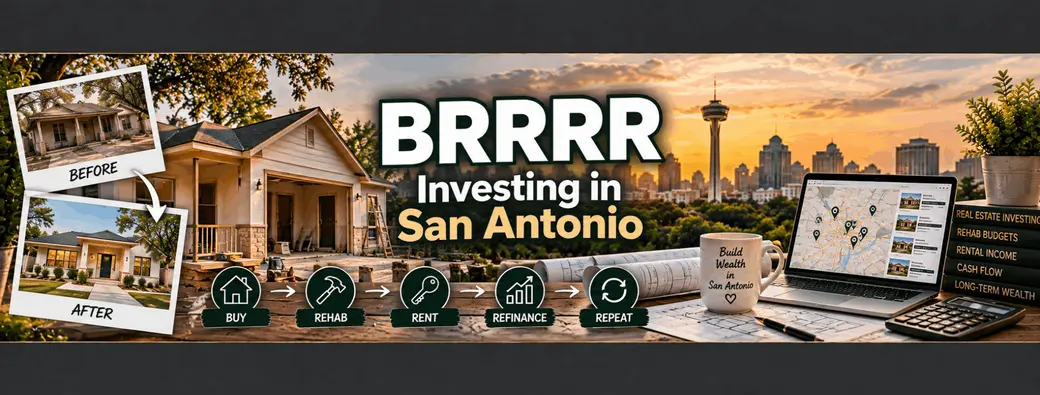
That's why many investors are drawn to the BRRRR strategy: Buy, Rehab, Rent, Refinance, Repeat.
The idea is straightforward. Find a property with value-add potential, improve it, place a tenant, refinance based on the improved property, and potentially reuse some of your original capital for another investment.
But successful BRRRR investing requires much more than finding a cheap house.
Purchase price, renovation budget, ARV, rent, financing, appraisal, operating expenses, and refinance terms all matter.
Here's how San Antonio investors can evaluate the BRRRR strategy before purchasing their next property.
What Does BRRRR Mean?
BRRRR stands for:
- Buy — Purchase a property with investment potential.
- Rehab — Renovate the property and create value.
- Rent — Place a qualified tenant and stabilize the property.
- Refinance — Replace the original financing based on lender requirements and the property's updated value.
- Repeat — Potentially use recovered capital toward another investment.
The strategy appeals to investors because it combines elements of value-add investing and long-term rental ownership.
However, the final "Repeat" only works when the first four stages are executed carefully.
Step 1: Buy the Right Property
Buy Below the Property's Potential Value
A BRRRR deal generally starts with buying a property where improvements may create meaningful value.
Investors may look for:
- Outdated interiors
- Deferred maintenance
- Properties with price reductions
- Longer days on market
- Back-on-market listings
- Cosmetic fixer-uppers
- Properties needing moderate renovation
- Seller motivation
The goal isn't simply to purchase the cheapest property available.
The goal is to purchase at a basis that leaves room for renovation, financing costs, operating expenses, and the property's future value.
Step 2: Calculate the ARV Before You Buy
ARV stands for After Repair Value.
It's an estimate of what the property could reasonably be worth after renovations are complete.
For example:
Purchase Price: $170,000
Estimated Rehab: $40,000
Estimated ARV: $285,000
That spread may look attractive, but investors should avoid using the highest possible comparable sale to justify the deal.
Look for renovated properties with similarities in:
- Location
- Square footage
- Bedrooms
- Bathrooms
- Property type
- Age
- Garage
- Condition
- Renovation quality
Your ARV should be based on a defensible range—not the number you need in order to make the deal look profitable.
Step 3: Build a Realistic Rehab Budget
The renovation phase is where many BRRRR projections can change.
A rehab initially estimated at $30,000 could become significantly more expensive if major problems appear after closing.
Review both cosmetic improvements and major systems.
Cosmetic Items
- Interior paint
- Flooring
- Kitchen updates
- Bathroom updates
- Lighting
- Fixtures
- Landscaping
Major Systems
- Foundation
- Roof
- HVAC
- Plumbing
- Electrical
- Water heater
- Drainage
Investors should consider getting professional inspections and contractor estimates when appropriate.
Build a contingency into the renovation budget. A project that only works if nothing unexpected happens may leave very little margin for error.
Step 4: Renovate for the Strategy
One of the biggest mistakes in a BRRRR project is over-improving the property.
Your goal isn't necessarily to create the most expensive house in the neighborhood.
Your renovation should support both:
- The property's expected rental demand
- The value you're attempting to create
Durable flooring, functional kitchens, clean bathrooms, neutral paint, reliable mechanical systems, and appropriate exterior improvements can often matter more to a rental strategy than unnecessary luxury upgrades.
Review renovated comparable sales and rental properties before deciding how far to take the renovation.
Step 5: Estimate Realistic Rent
The second major number in a BRRRR deal is rent.
A property may create substantial equity but still be a poor long-term rental if the monthly expenses significantly exceed realistic rent.
Research comparable rentals with similar:
- Location
- Bedrooms
- Bathrooms
- Square footage
- Condition
- Garage or parking
- Amenities
As of September 2026, Realtor.com reports a citywide San Antonio median asking rent of roughly $1,650 per month, but individual ZIP codes and neighborhoods can differ substantially. Investors should therefore underwrite using property-specific rental comparables rather than the citywide median.
Step 6: Calculate Operating Expenses
Never calculate BRRRR cash flow using only:
This calculation leaves out several real ownership expenses.
Depending on the property, consider:
- Property taxes
- Insurance
- Maintenance
- Vacancy
- Property management
- HOA fees
- Capital expenditure reserves
- Utilities paid by the owner
- Landscaping
- Leasing expenses
A BRRRR property still needs to make sense as a rental after the refinance is complete.
Step 7: Understand the Refinance Before Buying
This is one of the most important parts of BRRRR underwriting.
Don't wait until the renovation is finished to discover how your refinance might work.
Before purchasing, speak with lenders about factors such as:
- Loan-to-value limits
- Seasoning requirements
- Appraisal requirements
- Minimum credit requirements
- Debt-service requirements
- Interest rates
- Closing costs
- Reserve requirements
The property's ARV does not automatically mean a lender will refinance that percentage of the value.
Loan programs and underwriting requirements vary.
How the Refinance Math Can Work
Here's a simplified hypothetical example:
Purchase Price: $160,000
Rehab: $35,000
Total Before Other Costs: $195,000
Appraised Value After Renovation: $275,000
If a hypothetical refinance allowed a loan equal to 75% of the appraised value:
$275,000 × 75% = $206,250
On paper, that could potentially cover much of the original purchase and renovation basis.
But the real transaction would also include financing expenses, acquisition costs, carrying costs, closing expenses, lender requirements, and other variables.
The appraisal could also come in lower than expected.
This is why experienced investors model multiple scenarios.
What Happens If the Appraisal Comes in Low?
One of the biggest risks in a BRRRR strategy is relying too heavily on a specific future appraisal.
Imagine you're expecting:
ARV: $300,000
But the appraisal comes in at:
$270,000
Your potential refinance proceeds may be significantly lower than expected.
That doesn't automatically mean the property is a bad investment.
But it might mean you leave more money invested in the deal than originally planned.
Investors should ask:
Watch Your Property Taxes
Texas investors should pay close attention to property taxes when evaluating rentals.
The previous owner's tax bill shouldn't automatically be used as your future expense assumption.
Changes in ownership, assessed value, improvements, exemptions, and taxing jurisdictions can affect future tax obligations.
Use realistic tax assumptions when analyzing future cash flow.
Use Conservative Numbers
A BRRRR deal can look amazing when you assume:
- The lowest purchase price
- The lowest renovation cost
- The highest possible ARV
- The highest possible rent
- No vacancy
- No major maintenance
- The best refinance terms
Real-world investing rarely delivers every best-case scenario simultaneously.
A stronger analysis asks:
What happens if the rehab costs more?
What happens if rent is lower?
What happens if the appraisal is lower?
What happens if refinancing costs more?
If the deal still makes sense under reasonable conservative assumptions, you have a stronger foundation for making an investment decision.
Why San Antonio Can Be Interesting for BRRRR Investors
San Antonio gives investors a large and diverse housing market to analyze.
As of September 2026, Realtor.com reports roughly 14,722 active listings citywide, up about 4.6% from the prior year. The median listing price is approximately $289,900. The city is also classified as a buyer's market based on current supply and demand conditions.
That doesn't mean every listing is an investment opportunity.
But greater inventory can give disciplined investors more properties to evaluate before committing capital.
Different San Antonio ZIP codes also behave very differently, so investors should analyze deals at the neighborhood and property level instead of relying only on citywide statistics.
Common BRRRR Mistakes to Avoid
Overestimating ARV
Don't use an aggressive resale value simply because the deal needs it.
Underestimating Rehab
Detailed scopes and contractor input can help reduce surprises.
Assuming Maximum Rent
Use realistic rental comparables rather than the highest listing available.
Ignoring Refinance Requirements
Know your potential lender's requirements before starting the project.
Forgetting Holding Costs
Interest, insurance, utilities, taxes, and maintenance continue while you're renovating.
Over-Leveraging
A successful refinance doesn't eliminate the need for adequate reserves.
Having No Backup Plan
Consider what you'll do if the refinance, appraisal, renovation, or rental assumptions don't work exactly as projected.
BRRRR Property Analysis Checklist
- ☐ Purchase price
- ☐ Comparable sales
- ☐ Estimated ARV
- ☐ Rehab scope
- ☐ Contractor estimates
- ☐ Rehab contingency
- ☐ Acquisition costs
- ☐ Financing expenses
- ☐ Holding costs
- ☐ Property taxes
- ☐ Insurance
- ☐ Estimated market rent
- ☐ Rental comparables
- ☐ Vacancy reserve
- ☐ Maintenance reserve
- ☐ Property management
- ☐ Expected refinance terms
- ☐ Cash flow after refinance
- ☐ Backup exit strategy
How an Investor-Focused San Antonio Agent Can Help
A BRRRR investor isn't simply searching for a house.
They're searching for a combination of:
Price + Condition + ARV + Rent + Financing + Exit Strategy.
At Emerald Group, we help investors identify San Antonio properties that deserve deeper analysis.
That can include searching for:
- Fixer-uppers
- Price reductions
- Longer days on market
- Back-on-market properties
- Value-add opportunities
- Potential rental properties
- Motivated sellers
- Potential BRRRR opportunities
We can also help review comparable sales, rental activity, property history, and neighborhood-level market information as part of your due diligence.
Looking for Your Next San Antonio BRRRR Property?
Tell Emerald Group your buy box, budget, target neighborhoods, rehab tolerance, financing strategy, and investment goals.
We'll help you search for San Antonio properties that fit the strategy—and identify the ones worth analyzing further.
Search San Antonio Investment PropertiesDisclaimer: This article is for general educational purposes only and does not constitute financial, lending, investment, tax, legal, appraisal, construction, or property-management advice. Property values, renovation costs, rents, lender requirements, interest rates, taxes, insurance, and potential returns can change. Investors should independently verify all information and consult appropriate professionals before making an investment decision.
Recent Posts








"My job is to find and attract mastery-based agents to the office, protect the culture, and make sure everyone is happy! "